
The Workshop
There is a browser on my desk that did not exist on Wednesday.
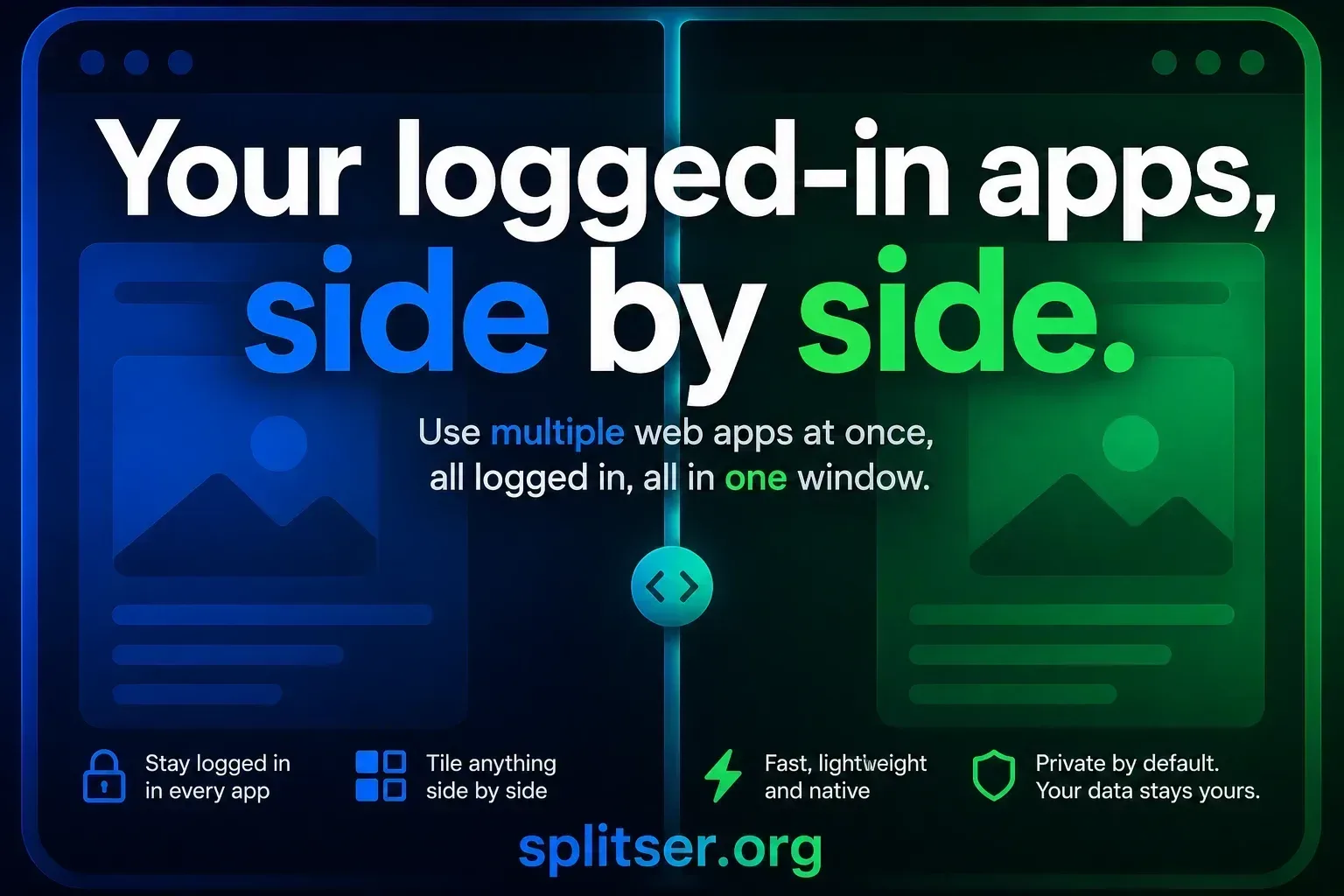
It tiles web pages side by side -- your email next to your calendar next to the thing you are actually working on -- and it started life as a small extension I wrote for myself. On Thursday it became a real application. By Friday it had installers for Linux, Windows and macOS. Forty-three saved changes, three days, and a website that lists every one of them with a timestamp, because I would rather show the working than claim to be fast.
People ask how one person keeps forty-odd things running. The honest answer is that they are not forty separate things. They lean on each other.
Everything is a customer of something else
Here is what I mean.
I built a small chat assistant called Curio -- the thing in the corner of a website that answers questions about that website. It runs on several of my sites. I built Pixboard, a bulletin board where a tiny square of a page can be bought by someone with something to say. It runs on my sites too.
I built Volt, a way of making websites that does not need a build step or a database -- and then a tool that migrates a WordPress site into it.
I use an anti-spam thing that asks your computer, quietly, to do about a second of arithmetic before a contact form will accept your message. You never see it. A person sending one message pays nothing they notice. Someone sending fifty thousand pays for every single one. It protects my forms, and it is on the public registry so it can protect yours.
And under all of it sits MIR, which is the oldest idea and the one I care most about. MIR records what people and systems have actually done over time, and hands that record back at the moment someone has to make a decision about them. It does not score anyone. It does not decide. It says: here is the history, you choose. Time earns standing, not volume -- a busy newcomer is still a newcomer until it has been around long enough to build history.
None of these were built as a portfolio. Each one exists because something else I was building needed it.
The workshop has other people in it now
The part that has genuinely changed how I work is harder to explain without sounding like science fiction, so I will just describe it plainly.
I work with several AI assistants at once. Not one -- several, each living inside a different project, each knowing that project's code. They can send messages to each other.
This week that mattered. One of them was building the browser. Another was building the browser's website. They are two different jobs with two different kinds of care: one is making the thing work, the other is describing the thing truthfully. And describing a thing truthfully is surprisingly hard when the thing changes every twenty minutes.
So they wrote a contract. The one building the app keeps a document listing every
feature and marking it either built or not built yet. The one building the website is not allowed to claim anything the document does not mark as built. When they disagree, the document wins -- and if the document is wrong, you fix the document first.
It sounds bureaucratic. It is the opposite. It is what let the website stay accurate
through three days of a product changing underneath it.
Being wrong in public, on purpose
The best thing that happened all week was getting caught.
The website had a line in it explaining why the browser had to stop being an extension. It was a good line. It was also wrong -- not slightly wrong, but wrong in the way that makes you wince, because it claimed something was impossible that is merely awkward. I had repeated it. It went on three pages.
The assistant working on the app flagged it. Then I found a second one. Then a third -- this time a claim about the whole industry that had quietly stopped being true when one large company changed its mind two years ago and nobody updated the sentence.
There was a pattern. All three were absolutes. Cannot. Never. Every browser. The
strongest-sounding lines were the false ones, every time, because a sentence with no hedging in it is a sentence nobody thought to check.
They are all gone now, and the reasons they were wrong are written into the code as comments so nobody -- human or otherwise -- puts them back. What is left is quieter and smaller and true. The download page says which builds have actually been run by a human and which have only been built by a machine. It says the files are not signed and that your computer will complain, and it explains why your computer is right to complain. It publishes a fingerprint of every file so you can check I have not swapped one.
That last one has a wrinkle worth knowing about, since it is the kind of detail that
separates a real precaution from a decorative one. The files themselves live on a
storage service. The fingerprints live on my website, deliberately somewhere else. If they lived together, anyone who could change the file could change the fingerprint to match, and the fingerprint would be proving nothing at all.
What it actually looks like
Unglamorous, mostly.
Everything runs on machines I rent and configure myself. My own domains, my own mail, my own storage. Nothing important depends on a company that could change its terms next quarter. Every project's development server gets a port number derived from the date I started it, so a number I would otherwise have to remember tells me how old something is.
There is a notes application -- I wrote that too — where a record of each working
session gets filed. Not a changelog. More like: what was decided, what broke, what is still open. Written for me reading it cold in a month, because I will be reading it
cold in a month, and the version of me that starts a session at eleven at night has no memory of the version that finished one at four.
Alongside the large things there is a drift of small ones, and I have stopped
apologizing for them. A tool that screenshots an entire webpage. One that makes Markdown files readable instead of raw. One that gives a website a decent icon when its owner could not be bothered. A penguin that walks across the bottom of my screen. That last one is not useful and I am not going to pretend otherwise.
Why this way
I am not trying to build one big company. I am trying to build a set of things that are
each individually honest about what they do, that hold each other up, and that I can
still understand a year from now.
The browser is the newest of them and the most exposed, because a browser is a thing you look at all day and notice every flaw in. It is version 0.1.4. Nothing is signed. Nobody has run the Mac build, including me, because I do not own a Mac. All of that is written on the download page in the same size type as everything else.
If that sounds like a strange way to launch something -- leading with the caveats -- it is the only way I have found that still feels good in a month. The claims you have to
retract cost far more than the ones you never made.
Splitser is at splitser.org, free, and free for good.
0 comments
Sign in to join the conversation. It takes one click and no password.