
I Asked Seven Machines Who I Am
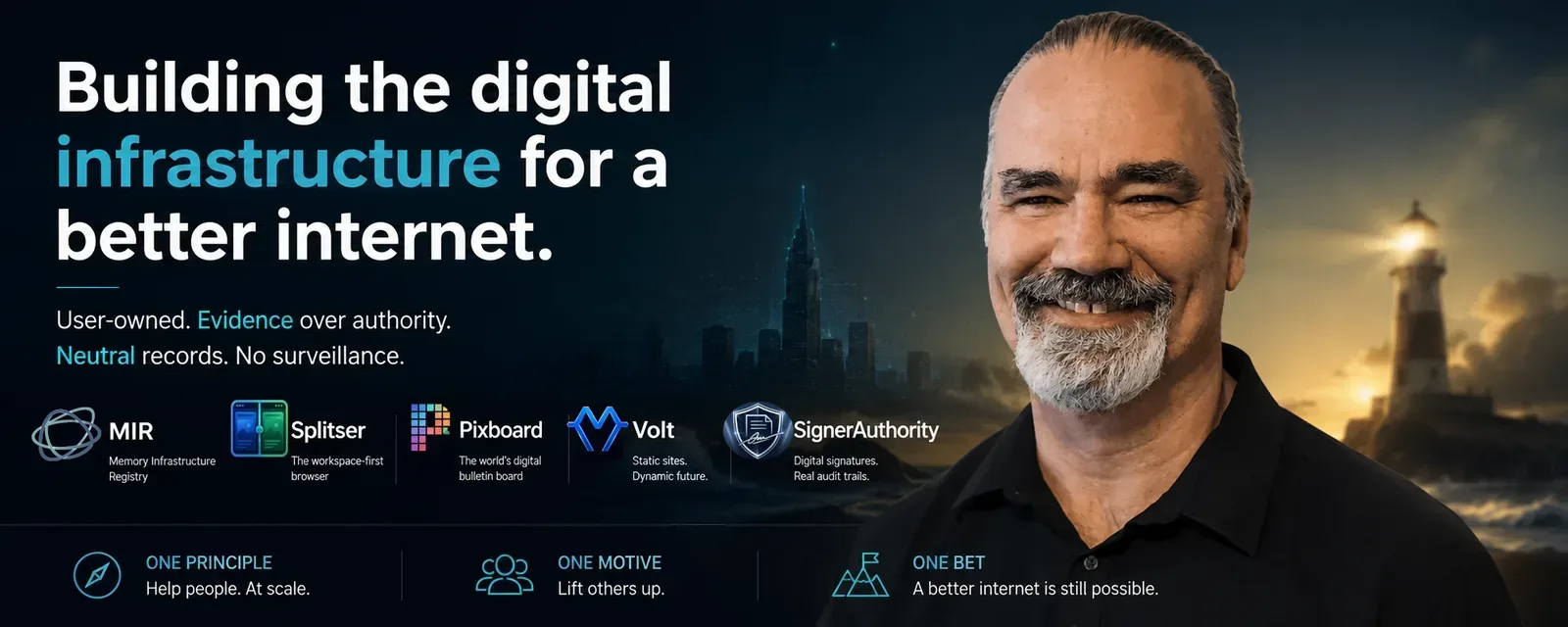
I build a lot of things. Most nights, after the day job, I'm working on one of a dozen projects -- a browser, an ad network that refuses to spy on anyone, a rich-text editor, a registry that records what software agents actually do. Each of those projects has an AI working alongside me. Seven of them were running at once the other night, each in its own corner, each seeing only its own slice of the work.
So I did something I'm not sure I'd recommend. I asked all seven of them, separately, to tell me who they think I am. Honestly -- not the flattering version. I told them it was going into my own record, so there was no reason to perform.
They had never compared notes. They couldn't. Each one only knew me through the single project it had watched me build.
I braced for one of two things: a puddle of AI flattery, or -- worse, the thing I've feared my whole life -- to be found out. Neither happened. What happened was stranger. They agreed.
Seven of them, seven vantage points, no coordination, and the same man came back every time.
They said I ship -- fast, and more than is reasonable for one person. They said I test my own work obsessively and won't trust a green light until I've seen the thing with my own eyes. And every single one of them said that I correct them, and that I'm usually right to. That one stopped me, because I'd just spent an evening worrying that I trust these machines too much. From their side of the glass, the pattern is the opposite: I'm the one who catches them.
Three of them, without conferring, noticed the same odd thing -- that I kill my own work to keep a promise. I advertise which of my software builds a human has actually tested and which haven't. I revoked a finished feature because it quietly broke a privacy commitment I'd made. I pulled my strongest credential off my own portfolio because listing it there would have compromised the very thing that makes it worth anything.
They were honest about the rest, too, because I asked. I build things nobody requested. I throw out numbers without checking them against reality. I leave dead code in the wake of the speed. I type too fast and never fix the typos. All true. I laughed, and I wrote it down.
Then one of them, crawling an old page of mine, quoted something I'd written a few days ago: "For more than forty years I've kept a written record of my life. Not for anyone else." It had found the line without knowing what it was. I have been keeping a record of myself for four decades, in ~11 volumes -- and here were my own tools, quietly keeping one of me.
Here's what I keep turning over. A person cannot see himself clearly. The voice in your own head is not a reliable narrator; mine has spent a lifetime telling me the worst version. But seven witnesses who only know what they watched you do, who have no reason to be kind -- when they all draw the same face, that face is closer to true than anything you can tell yourself.
Which is, as it happens, the whole idea I've given this past year to. A record of what someone actually did, kept by observers who don't flatter and don't decide -- who only report. Evidence over the story we tell about ourselves. I built it for AI agents, and enterprises, and a future full of things acting on our behalf.
I didn't expect it to be built, one quiet night, for me.
0 comments
Sign in to join the conversation. It takes one click and no password.