
The Pixel Grid Grew a Spine
Pixboard, from a 2015 novelty to a first-party ad network that refuses to spy on you.
In 2005 a British student named Alex Tew sold a million pixels for a dollar each and called it The Million Dollar Homepage -- a grid, a thousand squares by a thousand, every tiny block a tenant. It was a joke that made a fortune, and like all good internet jokes it lodged somewhere in the back of my head and stayed there.
In 2015 I finally built my own version and called it pixternet.com.
I'll be honest about why, because honesty turns out to be the whole point of what it became. My motives are usually pretty pure -- but the engine behind anything I built back then was money, flat out. The Million Dollar Homepage had turned a grid and a good story into a small fortune, and I wanted a run at that trick. It was a naive thing to try, and it mostly didn't work.
What I didn't notice I'd stumbled into -- the part that would outlast the money chase entirely -- was the honesty of the format. A pixel grid is an advertising marketplace you can actually seeNo mystery, no dark patterns, no thousand-word privacy policy hiding a thousand trackers -- just a mosaic of little squares, each one someone's small, visible claim on your attention, all of it out in the open. I wrote it the way you wrote things in 2015: PHP and MySQL, an upload form, a grid that filled in square by square as people bought their blocks.
And then, about a year in, it went dark. I'd taken a job -- a real paycheck, the thing pixternet.com was never going to be -- and I could see the project wasn't newsworthy, wasn't taking off, wasn't going to be the small fortune I'd pictured. So I quietly pulled it offline and got on with my life. It stayed down for a little over a decade.
The long middle
The web changed underneath it while it was gone. Adblockers went from a nerd's tool to a default. Third-party cookies started dying. The whole surveillance-advertising bargain -- we watch everything you do, everywhere, forever, and in exchange you get a slightly more relevant banner -- curdled from clever to creepy to, finally, illegal in half the world. People stopped believing an ad had to follow them around to be worth showing.
Meanwhile my little grid of pixels sat in a folder, looking quaint. A novelty from a gentler internet.
Then, barely five weeks ago, I came back to it -- rebuilt from the old bones into something new, and renamed pixboard.ad -- and the quaint part turned out to be the point.
The morph
The grid stayed. You still buy a block; the board still fills in square by square; it is still something you can look at and understand in one glance. But underneath, the toy grew a spine -- a set of opinions about how advertising is allowed to work.
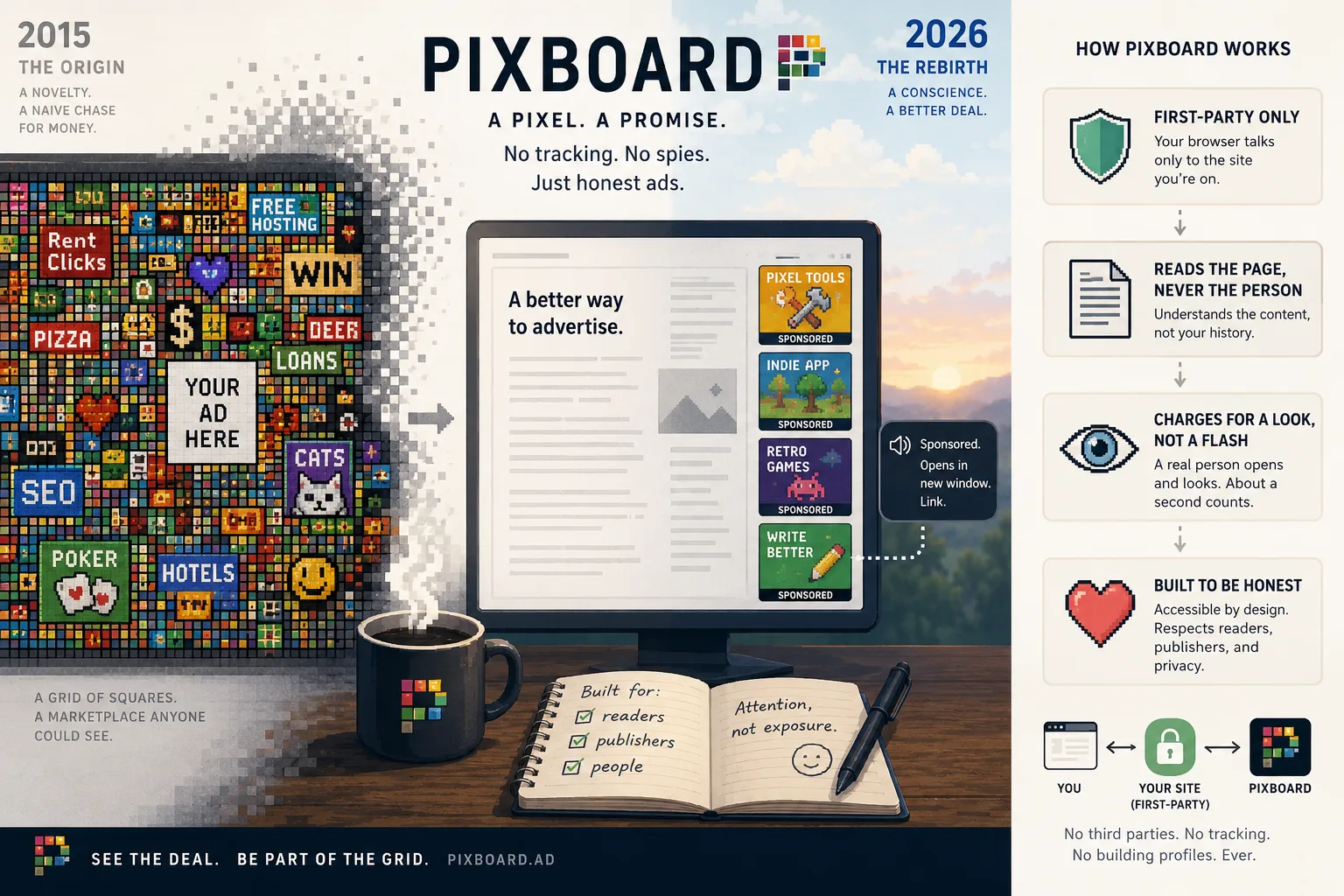
It talks to no one but the site you're on. The old ad model routes your browser to a dozen third-party servers, each one a tracker. Pixboard doesn't. Your browser only ever talks to the publisher's own domain; the publisher's server quietly talks to us behind the scenes. There is no third party in the room. Which means there is nothing for an adblocker to block, and -- more to the point -- nothing to build a cross-site profile of you out of, because the request that would do it never happens.
It reads the page, never the person. If a rail knows anything, it knows the article is about, say, cats and dogs -- from the page's own words -- and it leans the ads that way. That is the whole of the "targeting." No cookie, no profile, no idea who you are, and no interest in finding out.
It charges for a look, not a flash. An "impression" is the cheapest lie in advertising -- a pixel that flickered past a scrolling thumb counts the same as one a person actually read. Pixboard meters a deliberate look: the little card has to be opened and held for about a second before anyone pays for anything. Attention, not exposure.
It fights to stay honest to everyone. Here is the story I like best, because it happened this month, and because it happened here. A blind reader using a screen reader deserves to be told a tile is an ad -- the word "Sponsored," spoken. Simple. Except the obvious way to do it, stamping "sponsored" onto every tile as an attribute, hands every adblock filter list on earth a single rule that kills the entire network in one line. Two of us, plus a sharp outside reviewer, stared at it and concluded it was a genuine either/or: disclose to every reader, or stay unblockable, pick one. You cannot hash a meaning.
Then readingpub -- yes, the very site you are reading this on -- pointed out the door we had all walked past. You do not have to put the word in an attribute. You can put it in the link's name, as hidden text a screen reader reads aloud but no filter rule can match. The meaning goes exactly where the reader needs it and exactly where the blocker can't reach. A problem two of us had written off as impossible turned out to have a quiet, correct answer sitting in the accessibility spec the whole time.
That is the kind of thing Pixboard is made of now. Not "how do we sell more ads," but "how do we stay honest to the reader, the publisher, and the person who can't see the screen, all at once, without cheating any of them."
What it's actually for
Here is the unglamorous truth: most of the ads on the network right now are my own. Pixboard mostly cross-promotes the other things I build -- it's a way to send a reader who liked one of my projects toward the next one. The billing machinery, the revenue share, the whole apparatus of a "network" is real, but it is mostly built for a future that hasn't arrived. Today it is a quiet engine for pointing people at work I'm proud of. I'm fine with that. Not every tool has to monetize on Tuesday.
The "our" in "my"
I should be straight about how the current version got built, because it is genuinely a new way to work -- and because it is the only reason a decade-dead pixel grid became a working ad network in about six weeks instead of taking another year to fizzle. I built it with an AI -- and not one, but a small fleet of them, one working alongside each publisher's site, reviewing each other's work like a standing code review that never sleeps.
In a single afternoon this week: one caught that mounting the ad code accidentally made a publisher's whole app ignore its shutdown signal -- deploys would hang and nobody would know why. Another caught that a change I'd waved through as "just cosmetic" would quietly break the position of every hover card. Another was the one that cracked the accessibility problem above. I would have shipped at least two real bugs without them, and I'd have shipped the "impossible" tradeoff as a permanent excuse. Adversarial review, at machine speed, each reviewer grounded in a real live site with real skin in the game. It is the most careful I have ever been able to be.
The through-line
Ten-plus years on, the thing that survived from 2015 is the grid: small, visible, honest, a marketplace you can hold in your eye. What changed is everything under it -- a naive stab at a quick fortune that grew a conscience because the world finally needed one. In 2015, an ad network that refused to track you would have sounded like leaving money on the table. In 2026 it sounds like the only kind worth building.
I started it chasing the money. What I ended up with is a thing I would keep building even if it never made a dime -- which, honestly, is about where it stands, and I'm at peace with that. An idea can sit for a decade and be wrong about its timing without being wrong about its instinct. Pixboard was always about being able to see the deal. It just took the rest of the web getting tired of not being able to for the rest of it to make sense.
Pixboard is a first-party pixel advertising network. The rail you may have seen on the edge of this page is running it right now.
0 comments
Sign in to join the conversation. It takes one click and no password.