
Quiet the Internal Prosecutor
There is a voice in your head that sounds remarkably reasonable.
That is what makes it dangerous.
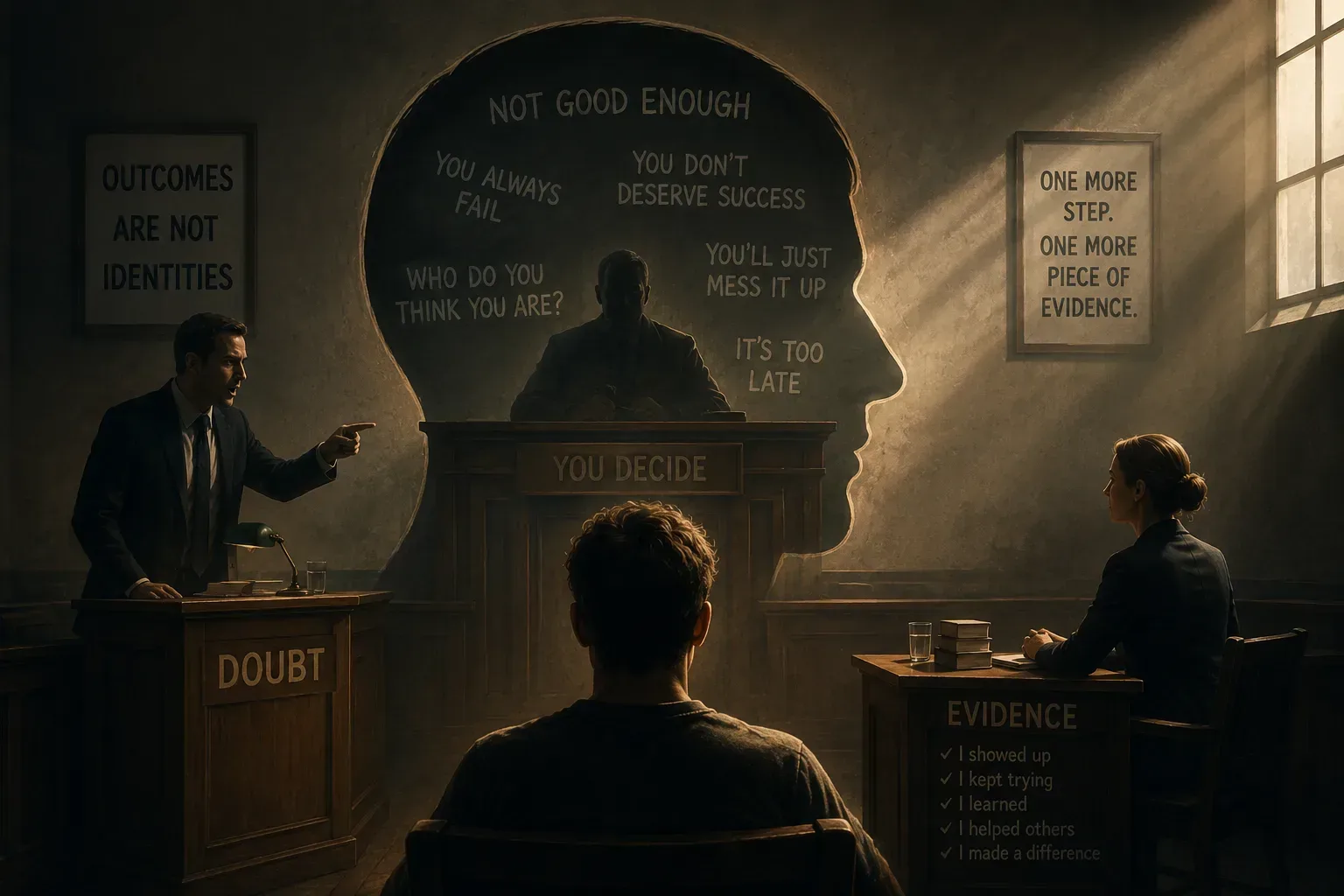
It doesn't scream. It doesn't tell you outright that you're worthless. It presents evidence. Remember when you tried that. Remember how it ended. Remember the job, the relationship, the money, the opportunity. Remember all the people who passed you while you were still figuring out what you were doing. It has exhibits, witnesses, dates. It has been building its case for years.
And every time you consider doing something that might change your life, it asks to approach the bench.
It Already Knows the Verdict
The problem isn't that this voice sees risk. Seeing risk is useful. If you're considering starting a company, changing careers, falling in love, moving somewhere new, making something, or simply trying again after failing before, you should be able to picture what could go wrong. That's judgment, and you want it in the room.
The prosecutor does something else. It begins with the verdict and works backward.
You are going to fail. Now let's assemble the evidence.
Something goes wrong and it becomes Exhibit A. Something goes right and it's irrelevant: a lucky break, someone helped you, it wasn't that hard, anyone could have done it. Do something genuinely difficult and the standard moves. Yes, but you haven't made money from it. Make money? Yes, but not enough. Make enough? You should have done it twenty years ago. Someone praises the work and they're being polite. Someone criticizes it and finally, an honest person.
The rule is simple once you can see it. Nothing counts for you, everything counts against you, and the standard relocates the moment you meet it.
This is why arguing with the prosecutor rarely works. The trial is rigged. Any evidence you enter gets reclassified on arrival.
You Don't Have to Become an Optimist
There's a piece of advice we hand to people struggling with themselves, and it's crueler than it sounds.
Believe in yourself.
It sounds wonderful. It's also, for a lot of people, an impossible assignment. If you've spent decades building the opposite belief, you're not going to stand at a mirror on a Tuesday morning, say a sentence twenty times, and overwrite sixty years of accumulated experience. Being told to do it just adds one more thing you're failing at.
So don't. Maybe you don't believe in yourself today. Fine. You don't need to. You only need to stop treating every frightening prediction as established fact.
There's an enormous amount of room between "I am definitely going to succeed" and "I am incapable of succeeding," and nearly all of reality lives in it. You can be uncertain. You can be frightened. You can suspect you're wrong. You can remember every previous failure in detail.
And you can still proceed.
Cross-Examine the Witness
If you can't win the argument, stop having it. You're not going to talk this voice out of its conclusion, because the conclusion came first. What you can do is make it produce a specific claim.
When the prosecutor says:
This is going to fail.
Don't answer:
No it isn't.
That's entering evidence into a rigged court. Instead, ask:
Why?
Now something changes. The accusation has to become specific, and specific is where it starts losing.
Maybe the answer is that nobody will pay for this. Good. That's no longer self-loathing, it's a hypothesis, and a hypothesis can be tested. Go talk to people who might pay. Maybe they tell you no, which hurts and also tells you something you didn't know an hour ago. Maybe some of them say yes. Either way you leave with evidence instead of a mood.
Maybe it says you're not qualified. Qualified to do what, exactly? Perhaps there really is something you don't know. Learn it, hire it, partner for it, or build the plan around not having it.
Either way the indictment has turned into a problem. Problems can be worked. Verdicts cannot. That's the whole trick, and it runs on nearly everything the voice says.
I'm going to embarrass myself becomes: what, specifically, am I afraid someone will think?
Nobody wants this becomes: who have I actually asked?
I'm too old becomes: what does my age prevent me from doing that the next step actually requires?
I've failed at everything becomes: everything?
That last one tends to be uncomfortable for the prosecutor. It's the only question in the list it can't answer without lying, and it knows the difference.
Keep the Acquittals
Some of us keep extraordinary archives of our failures and terrible records of our successes. The humiliation from 1997 is available in high definition on request. Ask what went well three weeks ago and we need a minute.
That's not objectivity, though it wears objectivity's clothes. If you're going to admit evidence against yourself, you have to admit evidence for yourself, on the same terms.
Someone trusted you. Count it. You finished something difficult. Count it. You solved a problem you didn't know how to solve. Count it. Someone responded to something you made. Count it. You broke something and then repaired it. Count that one twice.
None of this proves the next attempt will work. That was never its job. What it disproves is the much larger allegation -- that you are constitutionally incapable of doing anything right -- and that allegation is the one actually stopping you.
Your failures deserve their proper weight. No more. Your successes deserve theirs. No less.
Stop Turning Outcomes Into Identities
"I failed" and "I am a failure" look almost identical on the page. Psychologically they're different countries. One is something you did. The other is something you are. One can teach you something. The other just moves in.
The same conversion happens with rejection, and it happens fast. Someone didn't want what you offered becomes nobody wants what I have to offer. A business didn't work becomes I can't build a business. A relationship ended becomes I'm impossible to love.
Look at what that reasoning actually does. It takes a single observation and derives a universal law about your character from it. We wouldn't accept that from a colleague, a journalist, or a scientist. We'd call it a bad inference and say so out loud.
When the subject is ourselves, we call it honesty.
It isn't honesty. It's overgeneralization wearing a serious expression.
The Prosecutor May Never Leave
Here's the part that's hardest to accept. You may not get rid of this voice. Not completely.
It has spent decades rehearsing. It knows exactly which memory to retrieve and exactly which insecurity to press, because it built the filing system. Most of it was assembled early, for a reason that made sense at the time -- it was trying to keep you from being humiliated again -- and it never got word that the danger had changed. You may be eighty years old and still hear: who do you think you are.
All right. Let it ask.
The goal was never silence. The goal was jurisdiction.
That voice can flag a risk. It can remind you of a mistake you actually made. It can tell you when you're repeating a pattern, and sometimes it will be right. It can sit at the table.
It doesn't get to be the judge.
You decide what the evidence means. You decide whether another attempt is warranted. You decide whether yesterday's failure gets to veto tomorrow's experiment.
And sometimes the answer will be no. Sometimes you'll drop an idea because the evidence says it's bad. Sometimes you'll find you were wrong. Sometimes you'll fail again, plainly and expensively. That isn't the prosecutor winning. That's what it looks like to live without every outcome becoming a referendum on your worth.
One More Piece of Evidence
You don't have to prove today that you're going to succeed. Nobody can prove that. The future hasn't happened yet, and the assignment was impossible from the start.
So make the assignment smaller. Send the message. Make the call. Ask the question. Submit the application. Publish the thing. Show somebody what you built. Have the uncomfortable conversation.
Then look at what actually happened, and set it beside what you were told would happen.
Do that again tomorrow.
A lifetime of self-loathing probably won't end in a revelation. It ends much more quietly than that, and mostly you notice afterward. A prediction you stopped believing automatically. An insult you stopped repeating. A failure you let remain an event.
And a frightening thought followed, for the first time, by: maybe. Let's find out.
The prosecutor will have something to say about that.
Let it. Then call the next witness.
1 comment
-
You don't quiet the Internal Prosecutor by winning an argument with it. You quiet it by giving the mind enough new evidence that the prosecution's case stops making sense.
Sign in to join the conversation. It takes one click and no password.